Blogs
The hidden innovation pipeline.
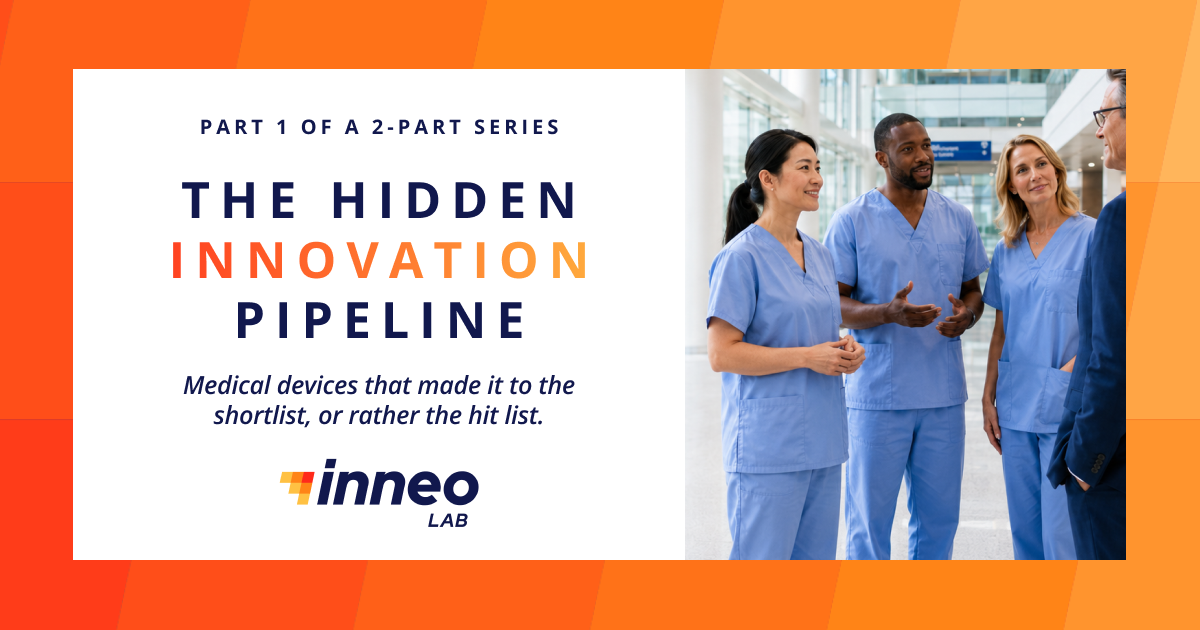
Medical devices that made it to the shortlist, or rather the hit list.
What if your next market opportunity has already been identified by the clinicians using your product every day?
At Inneo Lab, we decided to find out.
Medical device companies invest heavily in research, development, and commercialization to predict the next breakthrough. Yet they frequently overlook their most valuable source of insight: the frontline clinicians who use these life-saving tools every day.
In real-world clinical practice, physicians, nurses, and care teams routinely encounter usability challenges, workflow disruptions, performance gaps, and workarounds that manufacturers rarely see. Because these experiences seldom rise to the level of a formal product complaint, valuable insights often remain hidden from product development teams.
For industry leaders, that’s more than a visibility gap; it’s a missed opportunity. Frontline clinical experience shapes clinician confidence, purchasing decisions, product adoption, and market share. Organizations that systematically capture and act on these validated needs can build stronger product portfolios, reduce development risk, and uncover new opportunities for growth.
Looking beyond the product roadmap
This premise became the foundation for Inneo Lab’s Best Worst Medical Device (BWMD) initiative. Rather than asking clinicians to invent new technologies, we posed a simpler question:
What medical device do you “love to hate,” and how would you solve the problem?
Participants told us:
· The clinical problem
· Why the current solution falls short
· How the solution could be improved or reimagined
· What value a better solution would be worth
For this initiative, we intentionally removed traditional barriers to innovation. Participants did not need to build prototypes, write business plans, or conduct market research. Our objective was simply to capture authentic frontline insights before they are filtered through assumptions, organizational processes, or rigid product requirements.
The response reinforced something the industry already knows but rarely acts on: companies that start with a clinical problem clinicians have already validated are better positioned to build products that deliver real clinical value and reach adoption faster.
The opportunity hiding in plain sight
Across our member health systems, frontline users submitted valuable product feedback spanning everything from everyday consumables to sophisticated procedural instruments. The products differed widely. The message did not: some of the greatest opportunities are not waiting to be invented; they’re waiting to be recognized. The Best Worst Medical Device initiative is one example of what’s possible when clinicians become active participants in the innovation process rather than passive end users.
At Inneo Lab, our business model connects frontline clinical insights with product strategy, engineering, and commercialization. Because our team is embedded directly within health systems, we have real-time access to the everyday challenges and opportunities clinicians face. From validating an unmet clinical need to advancing a commercially viable solution, we help industry partners reduce development risk and build products that fit how care is delivered.
Coming in Part 2
In Part 2, we’ll share what the BWMD initiative revealed across four health systems, the recurring themes, and why “good enough” may be one of the biggest openings in today’s medical device market.
Curious whether your product made the list? If you’d like to know whether your device came up during BWMD — or if you have a product that would benefit from candid clinical feedback — we’d welcome the conversation. Contact Nishi Viswanathan, MD, MBA, Vice President of Product Management & Commercialization at Lab@Inneo.Health.